Pop quiz: Was GM's joint venture with the Shanghai Automotive Industrial Company the assembly plant to build variants of GM's truck designs?
If you answered that question affirmatively, you're informed - but incorrect. While that particular Chinese endevaor began in 1997 by building variants of the S/T pickup and utility, GM's first foray into the Asian truck market occured nearly two decades prior.
In 1981, GM entered into a joint-venture assembly in Taiwan. Working with Tua Hung Automotive, GM owned approximately 45% of the venture, which was based in Taipei. The plan was do send completely-knocked down kits of GMC trucks, and have them assembled and sold in Taiwan.

The product line was expansive, if not bizarre. While one could anticipate commercial-type vehicles for a developing market, GM apparently anticipated selling trucks that were more recreational in their nature as well.

Taking claim as the smallest and lightest truck in the lineup was the Caballero, GMC's clone of the G-body based Chevrolet ElCamino.
For one reason or another, GM saw fit to bring the car-based truck to Taiwan, and sold it with a 3.8L V6 standard, albeit the 4.4L and 5.0L V8s were optional.

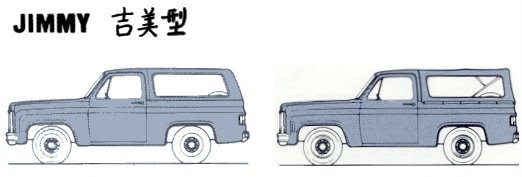
The two-door Jimmy was sold in both 2WD and 4WD variants. While GM had discontinued the soft-top option on C/K Jimmys and Blazers nearly 4 years prior, it was once again available for the overseas market.
The base engine was the 4.1 L inline-six, while the 5.0L and 5.7L V8s were available.

Suburban
For those desiring an even longer SUV, the Suburban was brought to the east in 2WD and 4WD models of both the 1/2 ton and 3/4 ton series.
The 5.7L V8 was standard. While the 6.6L V8 was available only on 4WD models, the massive 7.4L V8 was optional across all variants.

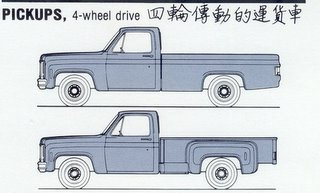
In much the same way that it represented the majority of GMC's domestic line-up, the Sierra was the largest model line in the entire Taiwanese project.The Sierra was offered in both 2 and 4 wheel drive variants, in either the 1/2 ton, 3/4 ton, or 1 ton series. As opposed to sticking with simply one bed design, buyers could choose between the wideside bed, or the flareside step bed. As pickups, the Sierras could be ordered as 1/2 tons, 3/4 tons, and 1 ton pickups.

The 4 door crew or bonus cab was also available on 3/4 or 1 ton pickups. The only way to equip a 4WD pickup with this cab was to order a 1 ton model.
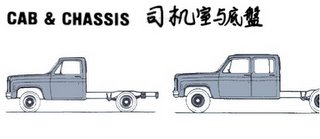
A wide variety of cab and chassis models were available. In 2WD form, one could order a Sierra chassis cab in 1/2 ton, 3/4 ton, and 1 ton models, usually with at least two different wheelbase models available. Like the crew cab, however, the only way one could attain a 4WD variant would be on 3/4 ton and one ton models.Unlike vehicles sold in the US, the Taiwanese-built Sierra chassis cabs could be equipped with a stake bed built and installed by the factory. Both 8 and 9 foot platforms were available.
All Sierras were capable of being equipped with the 4.1L L6, 4.8L L6, 5.6L V8, or the 6.6L V8. 2WD standard cab pickups also had the ubiquity of having a diesel option, but as it sadly was a year until the 6.2 V8 made it's debut, these Sierras were equipped with the infamous 5.7L Diesel V8. The 7.4L V8 was only available on Sierras equipped with either the crew/bonus cab, or as a cab/chassis model.

G-vans were also well represented in the foreign model range. Both Vanduras and Rallys were offered in all three chassis ranges, and were available in 4 different wheelbases. The 4.1L inline-six was standard, with the 5.0L, 5.7L, and 6.6L V8s available on larger models.

Contrary to long-wheelbase Rally vans sold in North America, the Taiwanese-built Rallys seated a maximum capacity of 5 people.
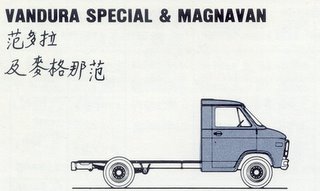
Cutaway models were also offered, along with the Union City built "Magnavan" utility body. All G-special models were of the 1 ton variety, and could be equipped with either the 5.7L or the 6.6L V8.
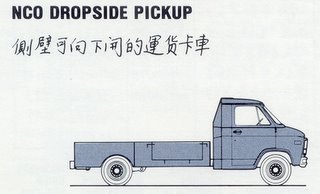
Unique to the Asian market was a bizzare G-van based pickup truck. Referred to only as the "NCO Dropside Pickup", it essentially consisted of a 1 ton G-special equipped with a cap to provide a back to the cab, and a dropside flatbed.
The bed specs read out as 11.25' long, and that it sported a 28" loading height from the side or rear. Powertrain consisted of either the 5.7L or 6.6L V8 engines.


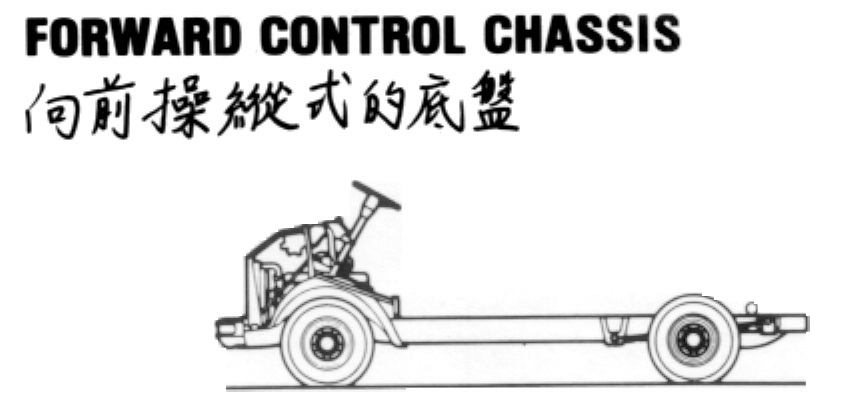
GM also apparently felt the need to market it's forward-control chassis overseas, as well.
Not only were bare P-chassis sold in 1500, 2500, and 3500 forms, but P-chassis equipped with steel or aluminum step-van bodies built by Union City Body Company were built and marketed overseas as well.

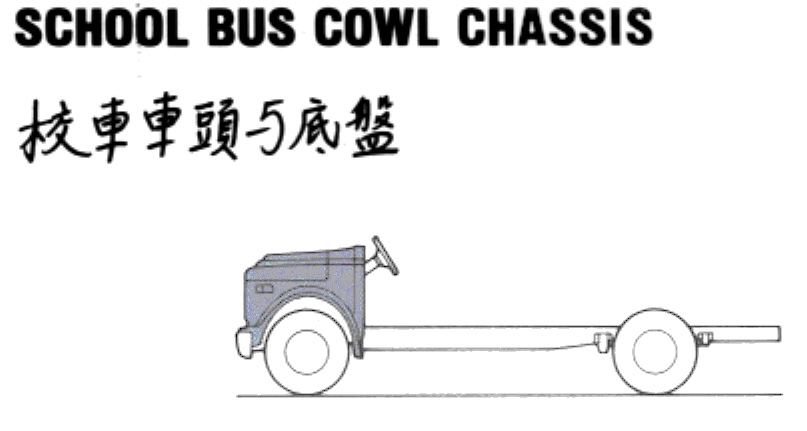
And, being malcontent to let the bus market alone, GM also brought the B-series chassis-cowl model in CKD form. Available in 5 different wheelbases, the B-series could be equipped with the 5.7L, 6.0L, or 7.0L V8s.
Before you can call out the hypocracy of no medium and heavy models being covered in this post, relax. Of all the literature obtained on this subject, we have the most on the Brigadier, Astro, and 7000 models offered in Taiwan, and will have more in-depth posts on those models in the coming days.
For undetermined reasons, the foray was not successful in the least. By the end of 1982, GM sold it's stake of Hua Tung Automotive, and exited the Taiwanese market. By 1989, GM returned via Yulon Motors, but sold vehicles of a non-commercial matter. Hua Tung has since been purchased by a number of other consortiums, and it appears to currently be a manufacturer of Toyota vehicles under license. 


 _______