_______
Harley Davidson Replica 20x9 Wheels (97-03 F150, 04 Lightning, Heritage)

Advantage Torzatop Soft Tonneau Cover (04-09 F150 5.5 ft bed - '09 No CM) - Advantage Truck Accessories, Inc. 73019
Advantage Torzatop Soft Tonneau Cover (04-09 F150 5.5 ft bed - '09 No CM)

Chrome Projector Headlights with Halo (04-08 F150)
Harley Davidson Replica 20x9 Wheels (97-03 F150, 04 Lightning, Heritage)
Our price: $249.99
Free Shipping

Advantage Torzatop Soft Tonneau Cover (04-09 F150 5.5 ft bed - '09 No CM)
Our price: $349.99
Free Shipping

Chrome Projector Headlights with Halo (04-08 F150)
Our price: $204.99
Free Shipping


Ford Racing Lowering Kit 2 In/1.5 In  (Rear) Drop (04-09 F150 2WD/4WD) - Ford Racing M-3000-G
Roush Cold Air Intake Kit (04-08 F150 5.4L) - Roush Performance 402101
Roush Cold Air Intake Kit (04-08 F150 5.4L)

Diablosport Predator Tuner (04-08 F150 4.6L/5.4L) - DiabloSport U7151
Ford Racing Lowering Kit 2 In/1.5 In (Rear) Drop (04-09 F150 2WD/4WD)
Our price: $129.99
Free Shipping

Roush Cold Air Intake Kit (04-08 F150 5.4L)
Our price: $336.99
Free Shipping

Diablosport Predator Tuner (04-08 F150 4.6L/5.4L)
Our price: $369.99
Free Shipping


More

WRAP-UP: 2007 Silverado LT2 Z714x4

Four months ago, I left home seeing a '07 Suburban LT2 4x4 parked in the driveway, and I returned to find an '07 Silverado LT2 Z71 4x4 occupying approximately the same amount of space. Consider this: both use the same (approximate) GVWR, platform, 4x4 system and 5.3-liter V8 with cylinder deactivation.

The more things change. C'mon - couldn't they have at least ticked the box for the VortecMAX 6.0-liter before handing it off to the GMT Blog?

Still, even having driven both short- and long-wheelbase GMT 900 utilities, the Silverado makes for a different yet satisfying drive. The changes between it and its SUV siblings are relatively small, yet the differences are enough to make it much more endearing to the weirdo progressive-nonconformist that I am.

First and foremost: I love the pickup-only dashboard. Yes, it's only on the "lesser trims" (W/T and LT), but I find it much easier to live - and drive - with than that on upper trim levels or on Tahoes and Suburbans. HVAC and audio controls - consisting of a multitude of tiny buttons - are now at a level where they can be inspected with minimal distraction. The biggest improvement is the new location of the transfer case switch (right-hand side of steering column). I can now actually see what drivetrain mode I've selected, as opposed to ducking behind the turn signal switch to read the miniscule LED indicators.

I've never owned a car without a front bench seat yet, so I'm enthralled that this truck has them as well. It took GM nearly ten years to copy what Dodge started, but the new span-to-span seat features spacious storage areas built within. The armrest features clips for papers and space for three Big-Gulps (simultaneously). In-seat storage keeps valuables both safe and (thanks to a 12-volt outlet) charged.

I'm also surprised at the truck's ride prowess. Normally, I've found most any pickup to ride harsher over broken surfaces than their SUV counterpart. Not so with the Silverado. Even with the off-road inspired Z71 package, the suspension soaks up rough pavement, potholed gravel and rough trail much better than the base Suburban did.

On the downside, room for rear seat passengers in the extended cab is tight, and the steering feels slightly sloppier than what was in the Suburban. Although the truck remains stable, the increase in feedback transmitted via the steering rack to the point where it almost feels twitchy. I'll attribute this mainly due to the weight bias of a pickup being over the front axle, but I'll be totally surprised - and in love - with a pickup that exhibits little to none of such bump steer.

GM claims its full-size pickup sales are least effected by gas prices than any other competitor, but that didn't prevent them from aiming for good fuel economy. Let's face it - at 15-16 mpg city and gas retailing at close to $3.30 a gallon, it wasn't cheap to keep the grey behemoth's thirst quelled, but the fuel economy was decent for a full-size pickup. Consider this - the V6 SRX that's currently in the driveway gets the same fuel economy, if not worse, despite its smaller motor and stature.

Some attribution for the reasonable fuel economy stems from the "Active Fuel Management" (re: cylinder deactivation), but my gripe with GM's system continues here. No, it's not noticible while switching between modes, nor does it impede accelleration all that much. My problem lies with the fact that it only seems to switch to four-cylinder mode when coasting. This system was designed to switch on during light accelleration as well, but no matter how gently the accellerator was touched, the 5.3 jumped back into eight-cylinder mode.

GM, we know performance is important, but c'mon - can't you give us an economy mode? Can't we (those who pay not only for the truck but for its fuel) a choice between balls-out performance and miserly economy? May I suggest a simplistic button that switches between two types of calibration? And may I also join the groves of armchair quarterbacks and consumers alike calling for the roll-out

My other qualm is surprising: the interior. Yes, I know I praised it not four paragraphs above, but there's still considerable room for improvement. The GM Truck Blog was invited out to GM's Milford Proving Grounds to flog their trucks against the competition. You'll hate me from a domestic-purist perspective, but from a 'all vehicles have an equal chance' point of view, Toyota's new Tundra should quickly become a benchmark for its interior, if nothing else. I've never been in a truck with so many creative storage compartments, including those in doors, armrests, seats, instrument panels, and elsewhere.

I'm also happy to see that an organized center console, capable of hanging file folders, has returned to the segment after the death of the Sierra Professional. Altogether, outside of switchgear, GM should - no, must blow this interior away when it comes to a mid-cycle refresh for the GMT 900.

But in terms of ride quality, performance and fuel economy, the Silverado's hard (if not impossible) to beat. It's been said about previous iterations, but it remains true for this generation of Silverado: it's one rock-solid package.
Read More … WRAP-UP: 2007 Silverado LT2 Z714x4 Read more...

INTRODUCTION - 2007 Cadillac SRX4


Is it a car? Is it a wagon? No, it's Superman...err, the SRX. Honestly, Cadillac's second stab at some sort of sport-utility is just as androgenous as Audi's Allroad. Some describe it as a jacked-up CTS wagon; as it rides on the same Sigma platform, it's actually just that (which brings up the odd possibility of making an AWD CTS. Hmmm...).

The last time a SRX fell into my hands was in 2003, eight months after they began rolling off the line in Lansing. That particular vehicle was completely loaded; Northstar V8, AWD, three-row seating, panoramic moonroof, etc.

Despite the content levels and the atmospherically-high pricetag, it wasn't a knockout.

Accelleration and performance was dogged by both the AWD and a slow-shifting tranny, while the CTS-cloned interior was pleasant - if you have a fetish for hard, triangular-patterned black plastics.

Three years later, there's another one of Caddy's androno-wagons sitting in the driveway. Already, I can state matter-of-factly that it blows the old one out of the lake.

The biggest change lies inside, with an all-new dash and instrument panel added for '07. After only two days of moderate driving, it's safe to say the changes are welcomed. Dash surfaces previously molded in rock-hard materials now have a pliable 'give' to them, while richly-stained birdseye maple (assuming it's real) and metalized-plastic vent trims break the otherwise-monotonous black interior. The seats resemble humanoid catchers' mitts; they're nicely bolstered and extremely comfortable even for long road trips. This particular example also is devoid of the third-row seating, which due to dimunitive size and a circus-like entry procedure, isn't missed.

Although this SRX doesn't have the Northstar or the new 6L50 six-speed, it does have GM's High-Feature 3.6L V6 with DOHC and VVT. It's good for nearly 255 hp and 254 lb-ft of torque, and for a GM motor, is actually happy to rev quickly. The French-built 5L40 five-speed auto's smooth, and when in sport mode, extremely quick-shifting. Manual mode is available - and while it won't replicate your favorite clutched-cog box, it does allow some personal control for hill grades or stopping.

Two things Cadillac hasn't touched are directly related to cost. The V6 SRX stickers at a meaty $38 grand, but with two option boxes ticked (V6 Premium Luxury Package and AWD), this example fetches just over $47,000. And with city fuel economy rated at 16 mpg, it looks to be a thirsty little bugger. Average fuel economy's still to early to call, but the in-dash multimeter's reading close to 17-18 mpg. At $3.18+ per gallon, it's nothing to sneeze at.

Still, there's two or three months left to really flog this thing, including some good trailering sessions. If nothing else, hopefully by then I can finally nail down what type of vehicle this thing is.
Read More … INTRODUCTION - 2007 Cadillac SRX4 Read more...

Can Your Rampside Do This? The Corvair AGL-4


My mind does the strangest things while I'm online - today, for instance, it steered me to a site on that blissfully bizarre military transporter, the M561 Gama Goat. What I ended up finding was footage of perhaps the sweetest Corvair prototype I've EVER seen (bar the Monza GT and SS, of course...). GamaGoat.com features a sales presentation for the AGL-4 (embedded below), perhaps the most capable Corvair 95 pickup ever built by GM.


Born in the early 1960s, AGL-4 was GM's stab at a 4wd, articulated cargo hauler. Albeit the exact history is unknown, the "Research Defense Laboratories" title suggests this project may have been pushed by Uncle Sam to replace that ubiquitous Willys/Ford product. The result: an articulated tilt-cab pickup, capable of scaling some apparently rigorous terrain. Defense Research Labs didn't have a good eye for marketing; you'll note none of the scenarios pictured in the film resemble warfare in any sort.


No further specifics on how this project transformed from the sweet semi-rigid you see here to that awkward six-wheel-drive creature the U.S. Army suffered with for ages. Interestingly, early Gama Goat prototypes did use the air-cooled Corvair mill for power, but the only piece of powertrain sourced from the General for production was the Detroit Diesel 3-53.


Read More … Can Your Rampside Do This? The Corvair AGL-4 Read more...

RTS Book - Coming Soon (As In A Year...)


I know I've not been a frequent blogger on this site.

But, there's a good reason. And a better reason why I'll continue not to be.

Over the past year, I've been researching the history and development of the Rapid Transit Series - or RTS - bus.

In a stroke of luck, Iconografix Publishing has taken an interest in the project, and wants to put it in print by this time next year.

In the meantime, however, I've got to continue researching, gathering images, and putting together a manuscript - within the next 6 months. All while continuing to work and attend sixteen credit hours of collegiate classes.

I'll be busy. We'll put it that way.

That said, thank all of you for your patronage, and I'll keep you all posted on the status of the book progress.

-Evan
Read More … RTS Book - Coming Soon (As In A Year...) Read more...

How To Build an Astro 95 Gas Turbine Special

Astro Test Vehicles @ GM Proving Grounds, 1969.  Can you find the Turbine?

So you've finally done it. You've gone and dropped nearly $100 for an extremely rare AMT 1/25 GMC Astro 95, including that vaulted and scarce turbine engine option.

Congratulations! You've not only captured a fine kit for your building hobby, but also my jealousy. I can only wish I could afford one.

Regardless, building the kit you hold in your hands won't give you a 'perfect' replica of the Astro Turbine demonstrator built by GMC. While the majority of what follows may constitute as "nit-picking" due to my obsessive nature regarding GMC history, there are a few major areas that need correcting before assembly.

That being said, here's at least a little bit of "detail oriented" specifics for how to "turbine" your rig.

http://img161.imageshack.us/img161/6783/astturbozh6.jpg

CAB DESIGN

1969 GMC Astro 95 Turbine

We may as well start here. Luckily, for the most part, any AMT Astro kit has a relatively early Astro cab that will work with this subject.

However, there are a few matters that will need correcting. Perhaps the most obvious are the "bus-type" mirrors that mount on the front corners of the cab, as opposed to the doors. Additionally, the "L"-shaped grab rails need to be replaced by a short, diagonal rail that runs from behind the front doors to slightly above the sleeper storage compartment.

Also worth noting are the long, bullet-style cab markers, and two individual train-type air horns on top of the cab.

Do note that the grille insert differs from stock Astros in that it has a vertical and horizontal pattern. More information relevant to the grille is given below.

PAINT SCHEME
The original issue of the Astro kit sported cover art that, in virtually all regards, was the Astro Turbine. A white cab, adorned with red wrap-around stripes that sandwiched a blue strip, is in fact the paint scheme GMC used on this particular truck.

What isn't shown, however, is a pseudo-grille section that was painted just above the actual grille opening. Throughout its 18-year production run, the physical grille opening on the Astro's cab was never enlarged, and the Turbine was no exception. GMC simply made the grille appear larger by using a painted section that matched the pattern used in the truck's custom grille.

And to further ease your painting woes, the remainder of the truck's chassis equipment - including battery boxes, steps, fuel tanks, suspension, and even wheels, were all painted a matching white. The front bumper, however, was chromed, as is the one included within the kit.

ORNAMENTATION
The Turbine had some minute ornamentation changes, that, if you're anal to no end for authenticity, you may want to consider applying to your rig.

The first - and most notable - is what to do with that "GMC" script on the front of the tractor. While stock Astros sported this on the metal header between the grille and the bottom of the windshield, the Turbine had this logo moved inside the grille. Position it as high within the grille as possible.

Astro Turbine Nameplate

Secondly, GMC modified the door nameplates. While normally they consisted of a large 'GMC' followed by a small "Astro 95" underneath, the Turbine changed the latter to read "Astro Turbine". Whether or not this detail is actually applicable, due to the scale size of the nameplate, is a debatable matter.


Finally, like all GM test vehicles, the Astro Turbine sported some corporate insignia just aft of the cab doors. "GMC TRUCKS" is spelled out, with a small box below it reading "GENERAL MOTORS CORPORATION". On the sleeper storage door, "ENGINEERING" is scripted in a similar font to the "TRUCKS" above, with a smaller "PONTIAC, MI" placed below that.

CHASSIS
While my eyes may deceive me, AMT's Astro kit represents a dual-axled tractor sporting a short wheelbase.

And while I don't have exact dimensional data for the Turbine, the photos I do have show a significant distance between the cab and the front of the trailer. Perhaps a 1/2" stretch of the frame rails would be in order to give an approximately correct look.

Another major error is with the truck's rear suspension. AMT provides the Astro with a walking-beam dual axle set-up, when, in fact, the Turbine was equipped with the "Astro-Aire" suspension.

At the time a relatively new design for GMC, this air-suspension system is better represented by the one included in AMT's GMC General or Chevrolet Bison kits. Consider swapping the former out for the latter - which may be a bit of work.

Note too the side-mounted accessories. There are no rear-mounted battery boxes, only small boxes encased with cab steps. Additionally, the Turbine does not sport the cylindrical fuel tanks, but a modified rectangular format. Perhaps the best bet to model these would be to fill in the notched step on the tanks AMT includes.

ENGINE
So what's the use of making a Astro Turbine look-alike if there's not actually a turbine under the cab? Absolutely none, if you ask me. I try to avoid curb-sides unless I'm extremely lazy.

Thus brings up a big issue. "What in the hell color do I paint the engine?"

While I trust the accuracy of the AMT of the past, I'm going to have to call "shenanigans" on this kit. The box illustration claims the motor included is the GT-404. As far as my records show, this particular Astro used the GT-309. It wasn't until the mid 1970s that an Astro SS was equipped with a GT-404, and sported a completely different paint scheme.

To date, the only images I have of the GT-309 are completely in two colors - black and white. While this is great for detail specifics, it doesn't allow for discernation of pigmentation.

That said, there are two routes to take with this:

  • Fire Red: Personally, I've only seen one GM gas turbine installed in a vehicle, and that was within Firebird I. This engine, the unrelated GT-302, was painted red, which also seems to match what AMT has depicted on the side of the box.

  • Detroit Diesel Green: The Astro Turbine was built sometime around 1970. What also happened that year was development of the GT-309, as well as all future commercial and industrial gas turbine development work, was sent from the GM Research labs to Detroit Diesel Allison (DDA). I've also seen a photo of a later GT-404 that was painted in DDA's infamous sage green. Subsequently, it could be argued that it would be an appropriate hue for the body.


You may be tempted to paint some additional metallic colors abound on the round sides of the engine, which are it's regenerative discs. In actuality, DDA was quite lazy, and painted the entire engine this color. Feel free, however, to detail the starter and control mechanisms on top of the engine in various shades of metal.

Also note the enlarged exhaust stacks. Unlike most trucks, these stacks were not chromed; nor were they even metallic in color. These were entirely painted white, in an attempt to call attention to the clean-burning nature of the turbine powerplant.

TRAILER
Like many of GM's dedicated show trucks of that era (ummm...the Astro and the Turbo Titan III, I suppose...), the Astro Turbine had it's own trailer, used both for display and for loaded testing.

Should you want to construct this for a complete display, finding a standard US-style box trailer should provide you a fine baseline for construction. This was painted silver, and had a wild red, white, and blue stripe wrapping around the sides of the van.

Special thanks go to Frederic Brede for providing the majority of these images.
Read More … How To Build an Astro 95 Gas Turbine Special Read more...

Coming Soon to a Speed Trap Near You - The 2007 Tahoe Police Package

2007 Tahoe Police Vehicle

While not mentioned in any part of GM's long lead press release for 2007, these are some of the first non-GM photographs of the new 2007 Chevrolet Tahoe Police Package.

Externally, the Tahoe is discernable from it's height - or the lack therefore of. While the GMT 900 is a huge vehicle, the stance of the Police Vehicle is a bit lower than civilian models, perhaps attributable to the 17" steel wheels, shod with P265/60R17 tires.


The rear portal for trailering equipment is closed by a plastic plug. No mention of trailering equipment, let alone towing specifications, exists on the Police Vehicle page on GM's Online Order Guide.

2007 Tahoe Police Vehicle Interior

Internally, the Tahoe sports twin cloth buckets up front, and lacks a center console. Dashboard trim is in a silver argent color, and the cluster has been changed to sport a certified 160 mph speedometer. The rear bench seat is trimmed in grey vinyl, and all floor carpeting has been replaced with black vinyl trimmings.

According to the order guide, the Tahoe Police Vehicle will only be available as a 2WD unit, powered by GM's 5.3L V8. Equipped with active-fuel management, E85 capability, and coupled through the 4L60-E automatic, this engine (code LMG) is identical in performance (320 hp, 340 lb-ft. torque) to the 5.3L available to the public.

Additionally, while GM's write up of the "Z56 Suspension" on the Police Tahoe cites it as being "police duty", comparison of it's specifications show no change in sway bar and shock absorber diameters from a standard 2WD Tahoe. As this is still preliminary information, this is not yet certain.

In addition to the above, Tahoe Police Vehicles will also come standard with:

  • High-capacity air cleaner

  • 160 amp alternator and 760 CCA battery (duals available as SEO)

  • Heavy-duty engine and transmission oil coolers

  • 3.73:1 Rear Axle Ratio

  • Skid plate package

  • "Police balanced" prop-shaft

  • Grounding studs and radio suppression straps

Read More … Coming Soon to a Speed Trap Near You - The 2007 Tahoe Police Package Read more...

A "Smart" Looking Bus, Indeed...


With the retirement of their last set of 1995 Nova RTS's, Southeastern Michigan's SMART has been primarily an all-Gillig Advantage fleet.

That is, with the exception of small buses. For more intricate links to surrounding communities, SMART operates what it deems "Community Transit" vehicles, which are usually built off of light-duty cutaway van chassis.

For the most part, these have been built upon Ford F-450 cutaways, but having sold a vast number of Ford buses just recently, SMART's come up with some new machinery - Chevys, to be exact.

The C5500 above is one of SMART's newest vehicles. Equipped with the 6.6L Duramax turbo diesel V8, and an Allison automatic transmission, the chassis also sports an ElDorado National "Aero Elite 320" body measuring 32' in length, and sporting a front wheelchair lift.

While the E-450 currently represents the majority of SMART's light-duty roster, expect more C5500's in the near future, should units like 25258 perform respectably.
Read More … A "Smart" Looking Bus, Indeed... Read more...

The Taiwanese Connection - Part 1 of 4

Shanghai Blazers

Pop quiz: Was GM's joint venture with the Shanghai Automotive Industrial Company the assembly plant to build variants of GM's truck designs?

If you answered that question affirmatively, you're informed - but incorrect. While that particular Chinese endevaor began in 1997 by building variants of the S/T pickup and utility, GM's first foray into the Asian truck market occured nearly two decades prior.

ODC Logo
In 1981, GM entered into a joint-venture assembly in Taiwan. Working with Tua Hung Automotive, GM owned approximately 45% of the venture, which was based in Taipei. The plan was do send completely-knocked down kits of GMC trucks, and have them assembled and sold in Taiwan.


Diversity...

The product line was expansive, if not bizarre. While one could anticipate commercial-type vehicles for a developing market, GM apparently anticipated selling trucks that were more recreational in their nature as well.


Taking claim as the smallest and lightest truck in the lineup was the Caballero, GMC's clone of the G-body based Chevrolet ElCamino.

For one reason or another, GM saw fit to bring the car-based truck to Taiwan, and sold it with a 3.8L V6 standard, albeit the 4.4L and 5.0L V8s were optional.


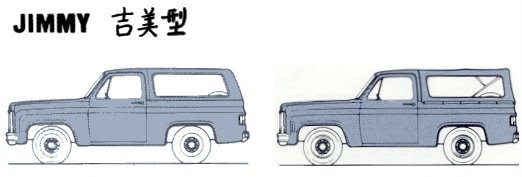
The two-door Jimmy was sold in both 2WD and 4WD variants. While GM had discontinued the soft-top option on C/K Jimmys and Blazers nearly 4 years prior, it was once again available for the overseas market.

The base engine was the 4.1 L inline-six, while the 5.0L and 5.7L V8s were available.


Suburban
Suburban


For those desiring an even longer SUV, the Suburban was brought to the east in 2WD and 4WD models of both the 1/2 ton and 3/4 ton series.

The 5.7L V8 was standard. While the 6.6L V8 was available only on 4WD models, the massive 7.4L V8 was optional across all variants.

Sierra C

In much the same way that it represented the majority of GMC's domestic line-up, the Sierra was the largest model line in the entire Taiwanese project.

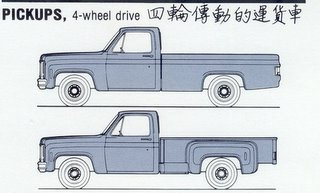
The Sierra was offered in both 2 and 4 wheel drive variants, in either the 1/2 ton, 3/4 ton, or 1 ton series. As opposed to sticking with simply one bed design, buyers could choose between the wideside bed, or the flareside step bed. As pickups, the Sierras could be ordered as 1/2 tons, 3/4 tons, and 1 ton pickups.

Sierra Crew Cab

The 4 door crew or bonus cab was also available on 3/4 or 1 ton pickups. The only way to equip a 4WD pickup with this cab was to order a 1 ton model.

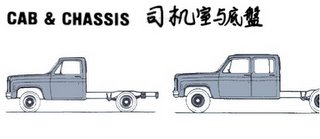
A wide variety of cab and chassis models were available. In 2WD form, one could order a Sierra chassis cab in 1/2 ton, 3/4 ton, and 1 ton models, usually with at least two different wheelbase models available. Like the crew cab, however, the only way one could attain a 4WD variant would be on 3/4 ton and one ton models.Unlike vehicles sold in the US, the Taiwanese-built Sierra chassis cabs could be equipped with a stake bed built and installed by the factory. Both 8 and 9 foot platforms were available.

All Sierras were capable of being equipped with the 4.1L L6, 4.8L L6, 5.6L V8, or the 6.6L V8. 2WD standard cab pickups also had the ubiquity of having a diesel option, but as it sadly was a year until the 6.2 V8 made it's debut, these Sierras were equipped with the infamous 5.7L Diesel V8. The 7.4L V8 was only available on Sierras equipped with either the crew/bonus cab, or as a cab/chassis model.


Vandura

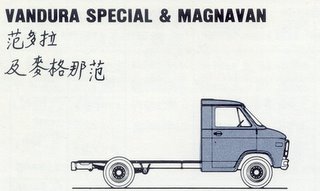
G-vans were also well represented in the foreign model range. Both Vanduras and Rallys were offered in all three chassis ranges, and were available in 4 different wheelbases. The 4.1L inline-six was standard, with the 5.0L, 5.7L, and 6.6L V8s available on larger models.

Rally Vans

Contrary to long-wheelbase Rally vans sold in North America, the Taiwanese-built Rallys seated a maximum capacity of 5 people.

Cutaway models were also offered, along with the Union City built "Magnavan" utility body. All G-special models were of the 1 ton variety, and could be equipped with either the 5.7L or the 6.6L V8.

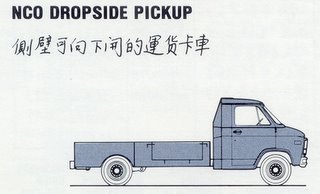
NCO Dropside Pickup

Unique to the Asian market was a bizzare G-van based pickup truck. Referred to only as the "NCO Dropside Pickup", it essentially consisted of a 1 ton G-special equipped with a cap to provide a back to the cab, and a dropside flatbed.

The bed specs read out as 11.25' long, and that it sported a 28" loading height from the side or rear. Powertrain consisted of either the 5.7L or 6.6L V8 engines.


PCchs

Value Vans

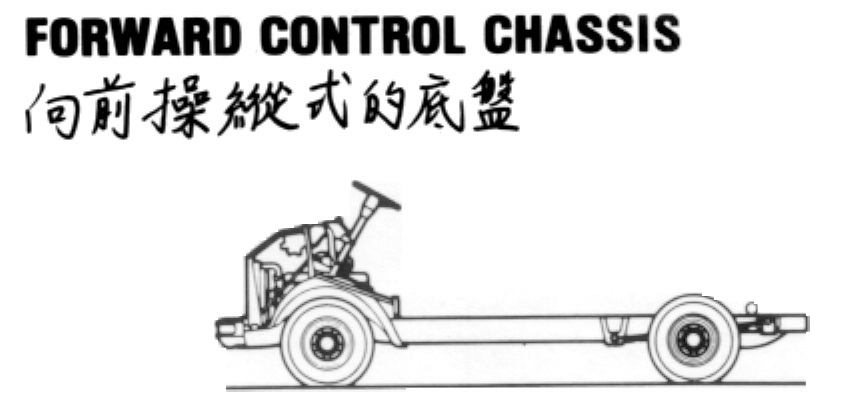
GM also apparently felt the need to market it's forward-control chassis overseas, as well.

Not only were bare P-chassis sold in 1500, 2500, and 3500 forms, but P-chassis equipped with steel or aluminum step-van bodies built by Union City Body Company were built and marketed overseas as well.


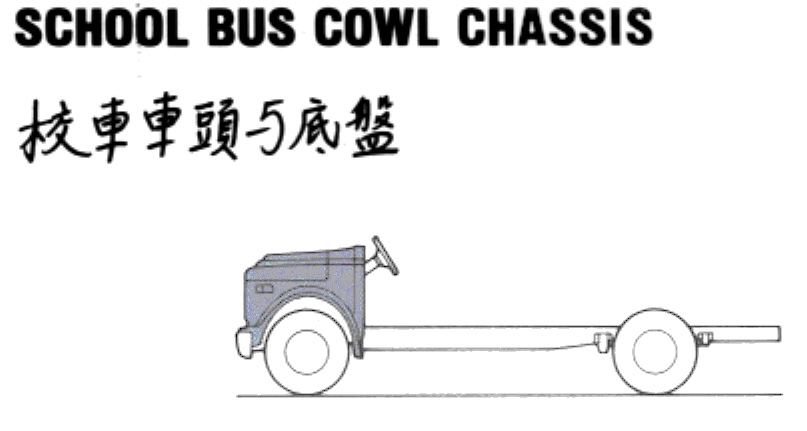
And, being malcontent to let the bus market alone, GM also brought the B-series chassis-cowl model in CKD form. Available in 5 different wheelbases, the B-series could be equipped with the 5.7L, 6.0L, or 7.0L V8s.

Before you can call out the hypocracy of no medium and heavy models being covered in this post, relax. Of all the literature obtained on this subject, we have the most on the Brigadier, Astro, and 7000 models offered in Taiwan, and will have more in-depth posts on those models in the coming days.

For undetermined reasons, the foray was not successful in the least. By the end of 1982, GM sold it's stake of Hua Tung Automotive, and exited the Taiwanese market. By 1989, GM returned via Yulon Motors, but sold vehicles of a non-commercial matter. Hua Tung has since been purchased by a number of other consortiums, and it appears to currently be a manufacturer of Toyota vehicles under license.
Read More … The Taiwanese Connection - Part 1 of 4 Read more...

How Badge Engineering Should Work - The New Isuzu Gala


Unlike the blatantly-ripped off i280, i350, and Ascender, Isuzu's newest piece of badge-engineering technology not only looks good, but is quite impressive with it's physical design. And, it will never make it to North American shores.


Enter the new Isuzu Gala, unveiled at the beginning of the year. Having merged it's bus operations with those of Hino in 2004 (the new J-Bus consortium) in dire economic times, the new Gala is literally a re-badged twin of the new Hino Selega.

But that's far from a bad thing. The new Gala abandons the boxy and disproportionate look of traditional Japanese highway coaches, and emulates instead European coaches, particuarly those of Setra.

The front fascia is aggressive, featuring raked front glass, and and an upward-moving side greenhouse. Headlamps are of a HID design, and rear lamps feature individual lenses in a stylized housing.

The dramatically modern styling doesn't stop inside, either. Passengers are seated within a smooth, flowing interior, surrounded by panoramic glass, and accentuated by colored LED mood lighting. Even the operator is given an ergonomic and enclosed interior, shown below.

And, in a move uncommon to North American coaches, the Gala features safety devices typical of automobiles. Not only is the operator provided with an airbag, but passenger seating is equipped with available 3-point seatbelts - something not found on your typical MCI coach.

Under the skin, the Gala rides on an electronically-controlled air suspension, with independant front arms, and a semi-independant trailing rear suspension. Power comes from a range of Hino's turbocharged inline-six cylinder motors, ranging from 12.9 to 13 L, and providing a maximum output of 450 horsepower. Shifts are controlled by a 6-speed transmission, which appears to be a clutchless-manual design.

So, how exactly does a re-badged twin benefit Isuzu? Simple. Not only does the new Gala fill a hole in their bus line-up, but it's also one of the most technologically advanced and stylish coaches in the Japanese market, let alone anywhere. The fact that such a coach can only be attained from either of the two companies is sure to benefit sales for either brand, and may draw more attention into Isuzu's Japanese showrooms - something that's always needed.

For more information, visit either Isuzu's webpage on the Gala, or Hino's on the Selega.

Read More … How Badge Engineering Should Work - The New Isuzu Gala Read more...

Rare Beast In Stock - T8500 Tandem


I love medium-duty GM trucks to no end, but I've a special place in my heart for certain models or configurations that I don't see all that often.

Case in point is the T-8500 tandem you see here. While the vast majority of T-series produced are in the 6500 or 7500 range, it's very rare to see an 8500, particuarly one spec'ed as a tandem rear drive - in stock at a dealer, no less.


And, if that weren't enough, the truck's equipped with an extremely long wheelbase. While it's wheelbase isn't not mentioned on the website, it could very likely be the EK7-code 260" variant.

This truck's equipped with a 245 hp version of the Duramax 7800, coupled through an Allison MDS3000 automatic transmission, and is available at Hardy Chevrolet of Gainesville, GA.
Read More … Rare Beast In Stock - T8500 Tandem Read more...

  © Blogger template Noblarum by Ourblogtemplates.com 2009

Back to TOP